
The University of Minnesota’s St. Anthony Falls Laboratory (SAFL) created the Healthy Waters Initiative in 2020. A major goal of the initiative is to study the impact on lakeshores and lake bottoms of various boats under different operating conditions. These studies included the creation of underwater and overhead videos to illustrate the findings. Recommendations on proper operation under different condition were made by SAFL. Further details on the initiative and links to the published videos are below.
MN COLA’s Position on Wake Surfing

MN COLA recognizes that wake surfing activities are fun water sports. Yet, if done where inappropriate, it/they can impact water quality, fishing, and threaten personal safety. Our goal is to keep Minnesota’s public waters healthy, safe, and available for all. To that end MN COLA has developed a position statement on enhanced wake activities.
MN COLA’s Comparison Videos
MN COLA took SAFL’s videos and assembled them into comparison videos to illustrate the difference between operating a boat at planing speeds, i.e. water skiing, versus semi-displacement speeds, i.e., wake surfing. The videos clearly demonstrate what happens to the lake bottom when wake surfing in shallow water.
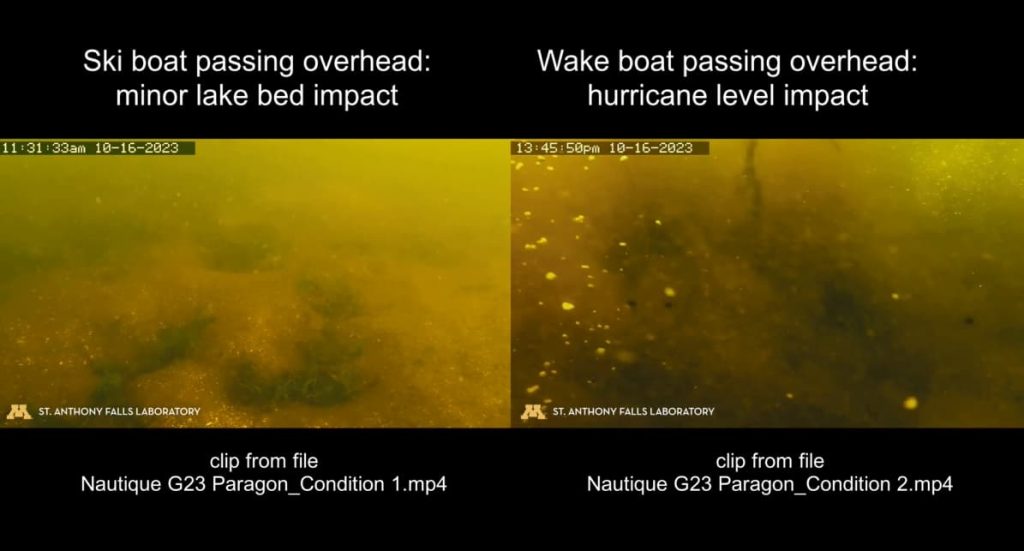
Here is a 20 second clip with a Nautique G23 Paragon wake boat. The image above is taken from the 18 second mark of this clip. The video shows in side-by-side display the lake bottom at 9 feet with the two modes of operation roughly synced to the boat pass overhead. The left side shows the bottom with the boat operating at planing speed (Condition 1) and the right side shows the same bottom spot with the boat operating in semi-displacement, or wake-surfing speed (Condition 2). The difference is obvious, the left side is benign while the right side is a hurricane.
Here is a two-minute clip with the same Nautique G23 Paragon wake boat. The video shows the lake bottom at 9 feet with the two modes of operation. The first 20 seconds shows the lake bottom with the boat passing over at planing speed. The rest of the clip shows the same lake bottom spot with the boat passing over at a semi-displacement, or wake-surfing speed. This second part continues at 5 minutes later and 13 minutes later to show the continued disturbance several minutes after a single pass.
Here is a two-minute clip with, again, the same Nautique G23 Paragon wake boat. This video shows the lake bottom at 14 feet with the two modes of operation. The first 22 seconds shows the lake bottom with the boat passing over at planing speed. The rest of the clip shows the same lake bottom spot with the boat passing over at a semi-displacement, or wake-surfing speed. This second part continues at 5 minutes later and 13 minutes later to show the continued disturbance several minutes after a single pass. Note that the disturbance is as bad as seen in the 9 foot depth clip above. The disturbance settles faster over time but is still present at 13 minutes.
SAFL also recorded video using an overhead drone to show the results between Conditions 1 and 2. Here is a two-minute split-screen video showing a Malibu VLX Wakesetter wake boat operating under both conditions. Four passes were made under each condition. A plume can be seen on the right side. No plume is seen on the left side. The video shows the plume 55 minutes after the first pass.
Using the same clips of the Nautique G23 Paragon here is a one-minute split-screen showing the different underwater and overhead passes roughly synced. The plume on the left is clearly seen in this pass #4 clip. The right side shows what is creating the plume.
SAFL recorded non-wake-boats operating in both planing and semi-displacement modes. Here is a 50 second split-screen video showing a Sea Ray SPX 190 Bowrider boat, which is not considered a wake boat. Both modes are shown side-by-side to illustrate the benign results under both conditions. Boat passes were made from two different directions. Note the benign results in the right side image after the boat passes over. The lake bottom disturbance is roughly the same for both modes of operation.
SAFL’s Healthy Waters Initiative
From the Healthy Water Initiative welcome page “The Healthy Waters Initiative (HWI) was established in 2020 by the Applied Research and Engineering team at the St. Anthony Falls Laboratory (SAFL). The motivation is to conduct research that increases our understanding of the anthropogenic influences on Minnesota’s aquatic resources and find solutions to real-word, practical problems, with the goal to help protect, preserve, and improve our prized lakes and streams.
“The HWI program is structured to focus on a single research topic for several years, with the goal of completing research and publishing data and results needed by stakeholder communities. When the team has sufficiently researched a topic, a new topic will be identified.”
The Healthy Water Initiative home page can be reached here. There you can access overviews and documents for each of the three phases. There is also a Project Updates page with updates dating back to the project’s beginning in 2020, providing a history of the project.
A major conclusion of Phase I was that “based on the data and our example method for determining recommended operational distance, we show that when operating under typical wakesurfing conditions, wakesurf boats required distances greater than 500 ft to attenuate wake wave characteristics (height, energy, and power) to levels equivalent to non-wakesurf boats operating under typical planing conditions.” (Executive Summary, bullet 7)
A major conclusion of Phase II was that “Wakeboats should operate in 20 ft of water or greater when in semi-displacement (surfing) mode to minimize impacts on the lakebed.” (Executive Summary, Key Findings and Recommendations, bullet 4) Another major conclusion was that “When operating in planing mode, it is recommended that recreational powerboats similar to the ones studied here, should operate in 10 ft of water or greater to minimize impacts on the lakebed.” (Executive Summary, Key Findings and Recommendations, bullet 1)
Healthy Waters Initiative Documents
Phase I is complete. Height, energy, and power of divergent wake waves were measured. The full report of Phase I can be found here.
Phase II is complete. Impacts on the water column and lakebed as boats traveled over was investigated. The full report of Phase II can be found here.
Phase III is underway with a scheduled report publication in the summer of 2026.
Underwater and Overhead Videos
Phase II included creation of underwater and overhead videos to illustrate what happens at the lake bottom and the associated spreading plumes with different boats, under different boat speeds, and thus under different modes of operation. Two operational modes were identified:
- Condition 1 where the boat is on plane (i.e., water skiing), and,
- Condition 2 where the boat is operated at a lower speed to generate larger wakes (i.e., wake surfing).
Wake boats have ballast tanks in the rear that add a few thousands of pounds of weight to the boat to drop the back end and create the large wakes. Wake boats also have trim plates or hydrofoils to further create the large wakes. Non wake boats generally do not have these added features. Refer to the specific manufacturers specifications for further details.
During the SAFL tests when operating the wake boats in Condition 1 (when planing) the tanks were empty and trim plates stowed. When operating on Condition 2 (wake surfing) the tanks were full and the trim/hydrofoil plates were at a mid-range. See the full Phase II Report for specific details. The non wake boats have no ballast tanks or trim plates and were configured the same for both conditions.
Four different models of boats were recorded on video:
- Malibu VLX Wakesetter – Wake Boat
- Nautique G23 Paragon – Wake Boat
- Sea Ray SPX 190 – Bowrider (non wake boat)
- Starcraft Limited 2000 – Deck Boat (non wake boat)
Underwater Videos
Three boats were operated in both conditions and one typical ski boat was operated only in Condition 1. The boats were driven over an underwater camera, each at two depths: 9 and 14 feet. Some videos also show five and 13 minutes after the boat pass.
Here are the individual complete underwater files from SAFL.
- Malibu VLX Wakesetter (wake boat) operated at Condition 1
- Malibu VLX Wakesetter (wake boat) operated at Condition 2
- Nautique G23 Paragon (wake boat) operated at Condition 1
- Nautique G23 Paragon (wake boat) operated at Condition 2
- Sea Ray SPX190 (bowrider boat) operated at Condition 1
- Sea Ray SPX190 (bowrider boat) operated at Condition 2
- Starcraft Limited 2000 (deck boat) operated at Condition 1
A compressed (zipped) file containing all seven underwater videos can be downloaded from here (2.48 GB).
Overhead Videos
Phase II also included creation of overhead drone videos to illustrate the debris spread and plumes under different conditions. The same boats used the create the underwater videos were used to create overhead videos. One boat was operated in both conditions, while the other four were operated only in Condition 2. Drones were used at different heights to show the resulting plume spread following a pass, and some videos include a time delay up to 55 minutes to show how long the plumes can last.
Here are the complete overhead files from SAFL:
- Malibu VLX Wakesetter (wake boat) operated at Condition 1
- Malibu VLX Wakesetter (wake boat) operated at Condition 2
- Nautique G23 Paragon (wake boat) operated at Condition 2
- Sea Ray SPX190 (bowrider boat) operated at Condition 2
- Starcraft Limited 2000 (deck boat) operated at Condition 2
The aerial drone videos compressed (zipped) file containing all five overhead videos can be downloaded from here (10.1 GB).
SafeWakes Seminar
MN COLA and the SafeWakes organization presented a seminar on April 16, 2025.
In a recent survey MN COLA members ranked “enhanced wake activities” as one of their three most pressing issues. To that end, MN COLA has worked for years on the environmental and safety challenges in recreation using enhanced wakes. Finding ways to share and protect our incredible water resources is the goal and it will require several steps.
One step is to raise awareness and increase the understanding of the impacts of enhanced wake activities across the boating population. MN COLA was a vocal proponent at the 2023 legislature, arguing for a mandatory boat operator’s license in Minnesota intended to improve safety on the water. Obtaining that license requires that boaters complete an education program that addresses among other things, best practices related to boating safety, AIS, and minimizing conflicts on the water.
Another step is obtaining the science to underpin possible solutions. MN COLA actively supports the work done by the St. Anthony Falls Laboratory (SAFL) at the University of Minnesota to understand the impact of boat wakes and propellor thrust.
And we believe that some form of regulation will be required to achieve the balance needed for recreation, safety, and environmental protection. Unfortunately, a statewide approach isn’t likely in the near term. In the interim, obtaining local regulations on surface water activities may be possible using the DNR petition process. In fact, it was used in 2024 by Caribou Lake in Cook County to establish surface water restrictions on enhanced wake activities. This special seminar was designed to provide an overview of the DNR petition process.
Here are links to materials from the seminar, including:
- The meeting presentation
- The Q&A that followed the presentation
- Presentation slides used in the meeting
- References discussed in the presentation