News

A Minnesota ‘lake killer’ surfaced 11 years ago. There’s still no long-term fix.

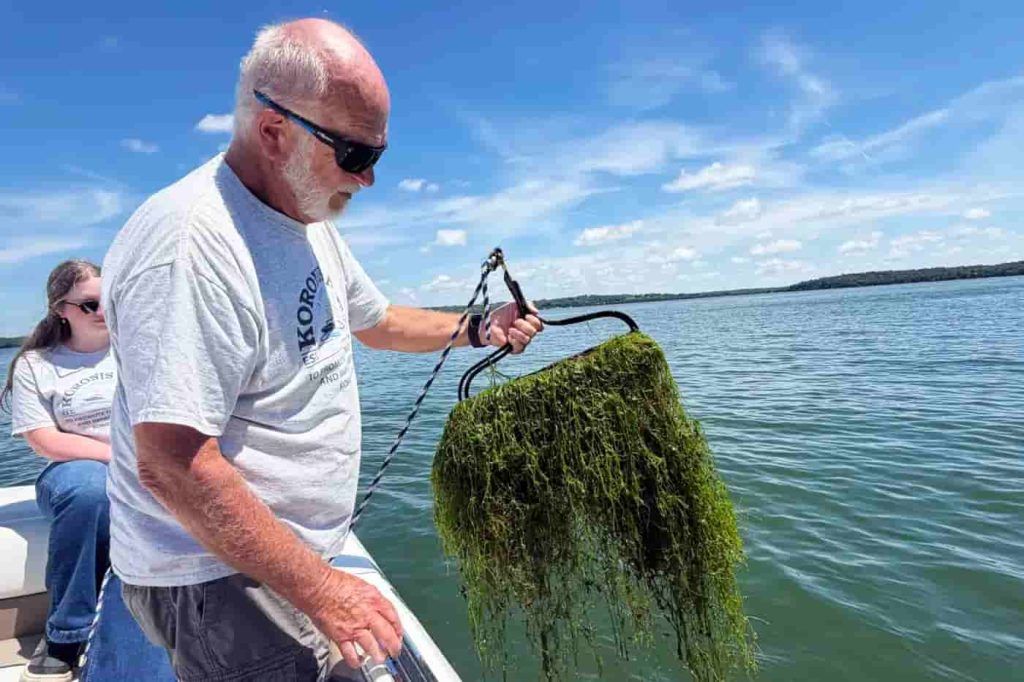
Kevin Farnum standing in a boat holding a rake full of starry stonewort
Kirsti Marohn | MPR News

Kirsti Marohn, MPR news, reported on the challenge of living with a starry stonewort infestation. Found first in Minnesota on Lake Koronis in 2015, starry stonewort has already spread to 40 lakes.

Kevin Farnum, MN COLA Board member, is spotlighted in this news report. The article provides perspectives on the challenges of living with starry stonewort. Like most of the other aquatic invasive species, there is no silver bullet to eradicate it, at least not in the near future. You can read the article or listen to it. The article has several useful photos and illustrations. The audio recording is just over seven minutes and well worth your time.
Many Minnesotans don’t value aquatic plants. The state’s lakes are paying a price.

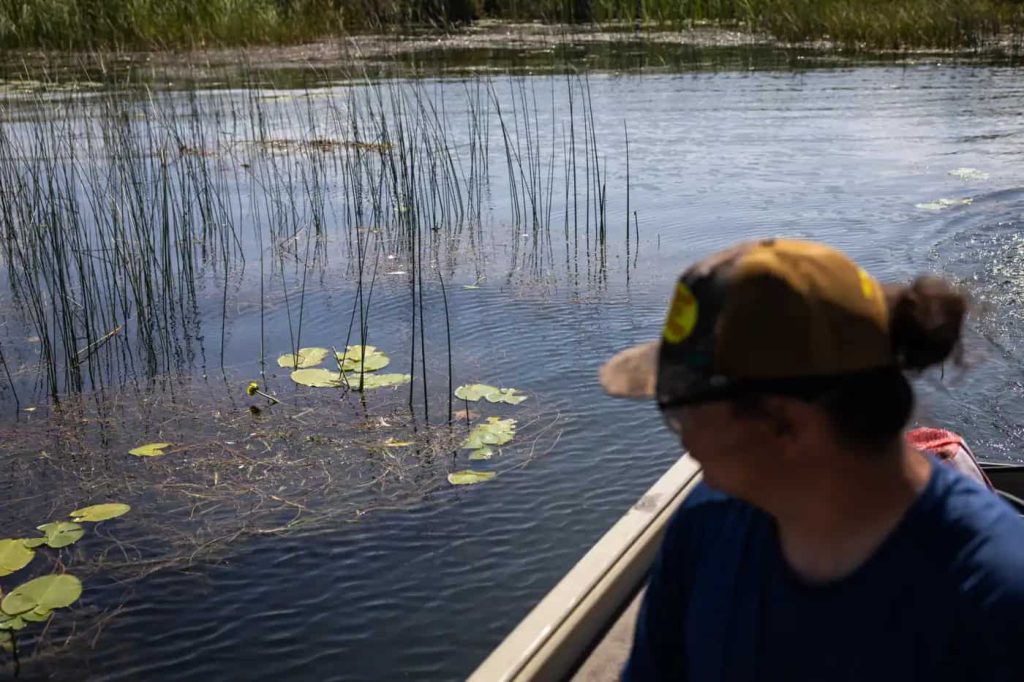
Raining White points out lily pads, bulrush and manoomin, or wild rice, along a healthy section of shoreline on Leech Lake in northern Minnesota on Aug. 19.
Ben Hovland – MPR News

Kirsti Marohn, MPR news, reported on one of the biggest challenges to keeping our lakes healthy… property owners who want to remove aquatic plants to create open water for swimming or boating. The article goes into depth on the damage this creates and on what results with the loss of native plants.

You can read the article or listen to it. The article has several photos and illustrations. The audio recording is just over seven minutes and well worth your time.
This is the latest addition to MPR’s ongoing series Trouble by the water: Minnesota’s lakes under threat series. Pass it on to your neighbors and association members!

Hubbard County COLA talks about starry stonewort

On July 30, 2026, the Hubbard County COLA meeting had two great presentations about starry stonewort and they are available for you to view and download.

MAISRC Minute logo show a wide shot of lake with a dock in the foreground

Ingrid Bey, a property owner on a Hubbard County lake, is also on the Advisory Board for the Minnesota AIS Research Center (MAISRC). Ingrid presented a MAISRC Minute focused on starry stonewort, from the basics and treatment options, to Starry Trek and the value that has been delivering for Minnesota Lakes. Here is a link to the video of her presentation along with the slides she used.

Title slide: Koronis Lake Association Fights Starry Stonewort "To Infinity and Beyond"

Kevin Farnum, from Lake Koronis, is on the MN COLA Board and has been working to combat starry stonewort since 2015 when it was found on Lake Koronis in Paynesville, MN. Kevin describes the treatment approaches they have used on Koronis as well as best practices in managing treatment efforts. Here is a link to the video of his presentation along with the slides he used.

Lake Lookout Program Needs You!

Lake Lookout Program logo - graphic of hands holding a binocular

The Lake Lookout program is a statewide effort by Minnesota Sea Grant and the Natural Resources Research Institute (NRRI). Its goal is to improve monitoring of chloride pollution and harmful algal blooms (HABs) in Minnesota lakes.

Hilarie Sorenson and Chris Filmstrip presented some great information about the program and harmful algae blooms (HABs) at our MN COLA Membership meeting in June. You can watch the video here.

For more information or to sign up your lake association contact Hilarie or Chris directly.

MAISRC pilots eDNA lab

U of MN MAISRC eDNA Lab title block and logo

The Minnesota AIS Research Center at the University of Minnesota (MAISRC) just announced it is piloting a new eDNA testing lab. They are currently recruiting volunteers who are interested in testing Minnesota’s lakes and rivers for zebra mussel eDNA.

You will need to act quickly if this sounds interesting and you want to volunteer, as the window for applying closes on June 12.

Early detection of aquatic invasive species (AIS) is an important factor in slowing or stopping the spread in a waterbody. More detections require more people. Fortunately, MAISRC research has demonstrated that volunteer-collected samples are as accurate as University scientists, making large-scale environmental DNA (eDNA) monitoring feasible.

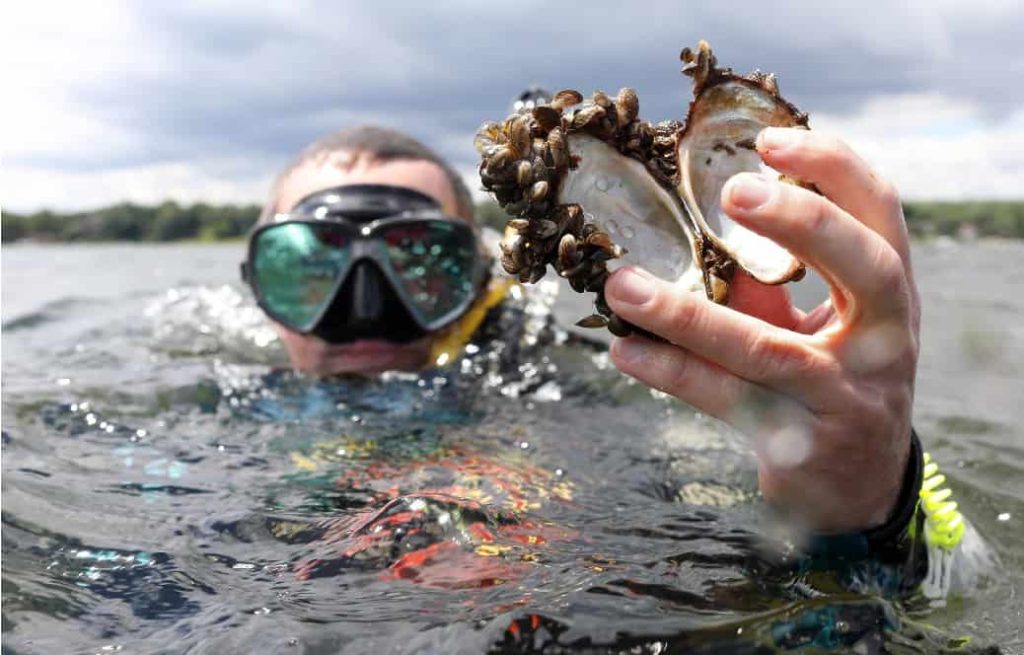
woman diver at the surface holding a cluster of zebra mussels attached to a clam shell

Now we are implementing this research to pilot an eDNA testing lab to monitor statewide. We are currently recruiting volunteers who are interested in testing Minnesota’s lakes and rivers for zebra mussel eDNA

Who can participate?
Individuals or groups such as lake associations, watershed districts, lake improvement districts, Tribal representatives, and others; we are excited to work with a variety of partners and to collect data for waterbodies with and without confirmed zebra mussel infestation. In addition to lakes with unknown zebra mussel status, we are accepting samples from lakes with previously confirmed populations of zebra mussels in order to validate our process.

What are participant requirements?
Participants are required to fill out an expression of interest form that contains the following information:

  • contact information of the person who will take the samples,
  • an estimated time for when you will sample the lake, and
  • an action plan for what you and/or your organization will do in response to the results. We recommend discussing this action plan with your local jurisdictional authority (LID, SWCD, other local unit of government, DNR AIS specialist, etc).

For lakes within the boundaries of Tribal reservations, permission from a Tribal representative to collect water samples for eDNA surveillance will be required.

What is MAISRC’s role?

  • Gauge interest and select participants
  • Send participants sampling kits containing everything needed for sampling. Participants will receive one kit per lake, if sampling multiple lakes, they will receive multiple kits.
  • Receive filters and equipment
  • Send sample results to participants and jurisdictional authorities

What is the timeline for this project?
This first season is a pilot with the goal of scaling up to test for more species and transition to being a fee-for-service model.

  • June 1 – June 12: Interest form is open
  • June 15: Participants contacted and selected based on availability of kits and other criteria
  • End of June/early July: Testing kits sent
  • July – August: Sampling takes place and results generated

If you are interested in participating in our eDNA pilot project, fill out the interest form below. If you have additional questions, reach out to the team: labtolakes@umn.edu.

Here is the eDNA Sampling Form.

What’s Your Plan for Used Boat Wrap? Recycle it!

Three images - top wrapped boats on the left and right, and the WRR logo and tag line "Give your Boat Wrap a Second Life" in the center

Wrap Recycle Right is the branded program of a nonprofit stewardship organization that represents boat wrap producers and develops and operates a recycling program under Minnesota’s Boat Wrap Stewardship Law (Minn. Stat. § 115A.1416)—the first such law in the United States. The Wrap Recycle Right program details are laid out at their website https://www.wraprecycleright.org/.

Across Minnesota, boats are starting to come out of storage. Wrap Recycle Right is continuing to expand collection options to make recycling more accessible for boat owners, businesses, and partners across the boating community.

Program Map

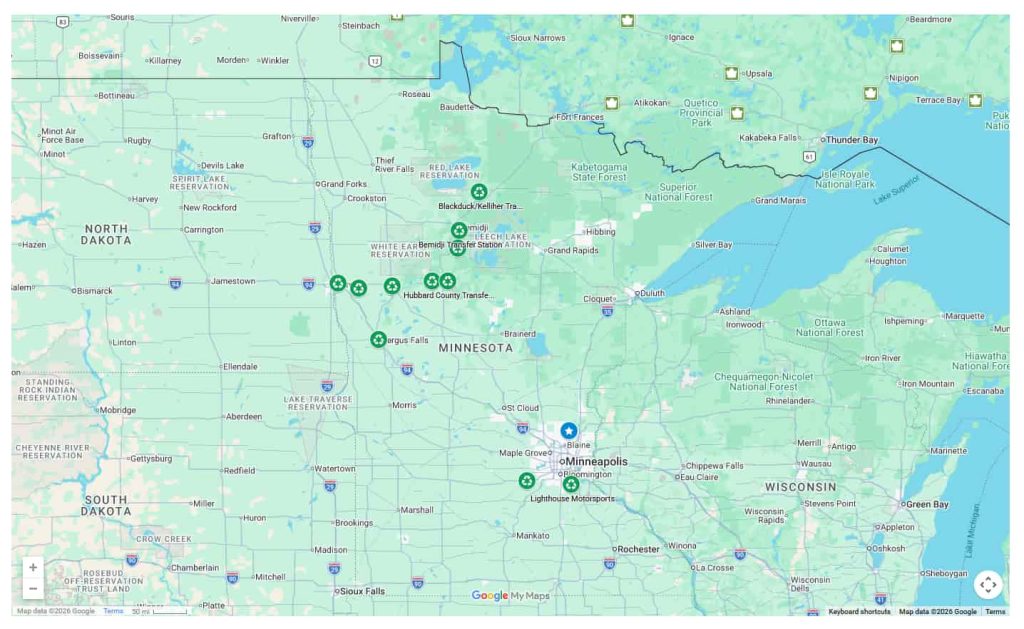
The interactive program map shows the confirmed drop-off locations for used boat wrap. The map will be updated as new drop-off sites come online. Click on the image below to open the interactive map.

static image of active Wrap Recycle Right rollout map as of 4/16/2026

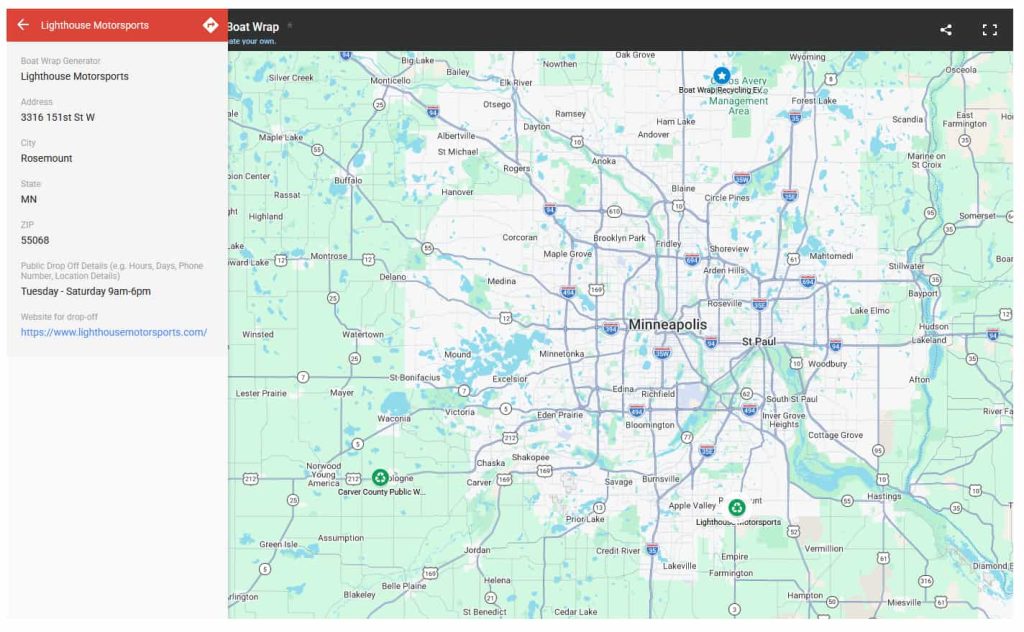
Clicking on a specific site will slide in information on that drop-off location and its open times.

closeup static image of active Wrap Recycle Right rollout map with a collection site selected as of 4/16/2026

Program Schedule

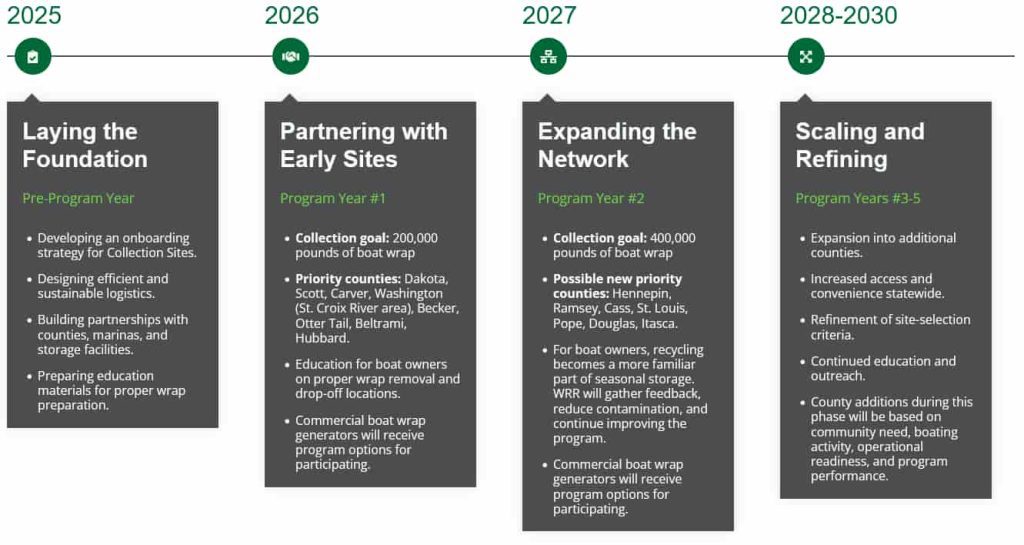
WRR program managers realize this rollout will take time for adoption across the state and they share their schedule here. Their program rollout is laid out in four stages over the next five years. Specific counties are on the schedule in the first few years. The schedule remains flexible in the later years as the program rolls out.

WRR Program Schedule as of 260416

For more information contact the program manager at info@wraprecycleright.org.

Wrap Recycle Right program logo

Boating industry position on safe surfing

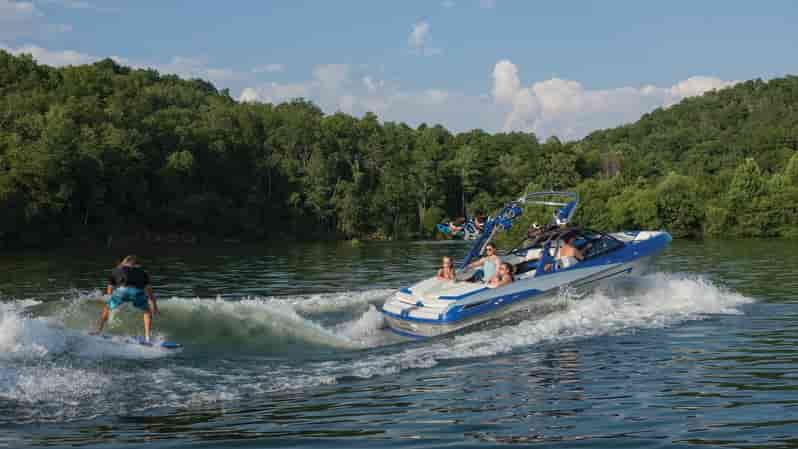
image of wake surf boat with surfer behind and people in the boat

The National Marine Manufacturers Association (NMMA), one of the principle marine industry associations, has released their position on wakesurfing. It should be of no surprise that they are pro-wakesurfing as their members include, among others, the surf boat manufacturers. 

NMMA is pushing this position across the U.S., Minnesota included. On December 26, Outdoor News, a Minnesota-based media outlet published a letter to the editor from NMMA detailing the NMMA wakesurfing position. 

NMMA states they support statewide regulations which are fair for all and science based. Unfortunately, they chose the research that their boating industry organizations have funded, which does not match the groundbreaking research from the University of Minnesota’s Saint Anthony Falls Laboratory.

NMMA believes a statewide standard that requires wakesurfing 200 feet from shore in depths of 10 feet or greater minimizes environmental impacts

The U of MN research on wave energy from wakesurfing suggest that the distances from shore need to be much greater to achieve a less destructive wave hitting the shore. And their research on lakebed impacts from wakesurfing suggest that the depth of water need to be much greater to minimize the environmental impacts.

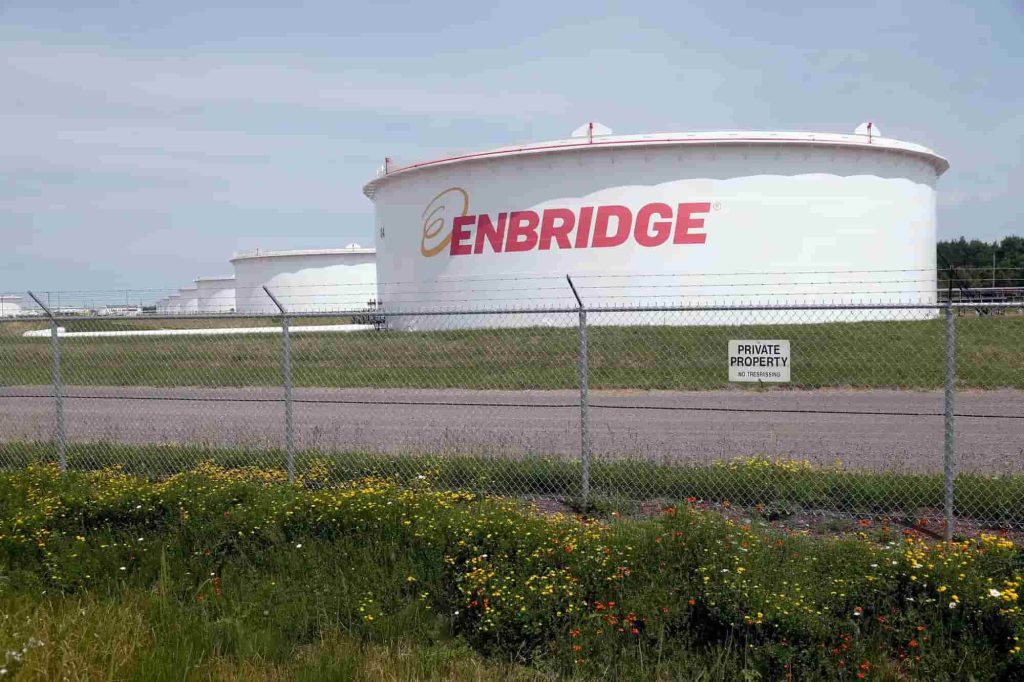
Enbridge, DNR reach $2.8M agreement to resolve Line 3 aquifer breach

image of large oil tank with Enbridge name

With the Christmas holiday approaching you may have missed this. 

On December 22, 2025, Minnesota Public Radio reported that Canadian company Enbridge has agreed to a nearly $3 million settlement for piercing a groundwater aquifer while building the Line 3 oil pipeline in northern Minnesota.  The MN Department of Natural Resources said it reached the agreement with Enbridge over the aquifer breach that was discovered in 2022 near Swatara in Aitkin County

A new $28M program for the environment

MN ENTRF Community Grant Program logo

Funded by Minnesota’s Environment and Natural Resources Trust Fund (ENRTF) and managed by the MN DNR, the new Community Grant Program will support projects for the public purpose of protection, conservation, preservation and enhancement of the state’s air, water, land, fish, wildlife and other natural resources.

The program will increase the number and diversity of grant recipients who receive ENRTF funding, especially in communities that have been adversely affected by pollution and environmental degradation. Grant awards will benefit communities and residents in all regions of our state.

During the 2025 session, lawmakers appropriated just over $28 million from the ENRTF to the DNR for the Community Grants Program. That funding is available until June 30, 2029. The MN DNR is in the process of developing the structure and processes of the program. We will try to keep you in the look as more becomes known. In the meantime, you can get more information on this exciting new program on the DNR’s website.

Join the Minnesota Cattail Collaborative

MN Cattail Collaborative logo

This project, part of the MAISRC Lab to Lakes initiative, is testing invasive cattail management across Minnesota lakes; restoring native nearshore habitats, reconnecting lake ecosystems, supporting healthy fish communities, and empowering local management through participatory science.

Groups such as lake associations, watershed districts, lake improvement districts, state park managers, and others can participate.

If you have invasive cattails and want to get involved in this exciting research work, check out the Cattail Collaborative webpage for more information.  MN Sea Grant and MAISRC are recruiting participants this winter. They will be hosting a virtual workshop for participants and will help participants find management partners.