
Category: Issues

MAISRC recruiting for “Lab to Lakes” Project Manager

MAISRC-logo

The Minnesota AIS Research Center at the U is accepting applications for a new Lab to Lakes Project Manager position. The Lab to Lake Project was funded by the State of Minnesota to move management recommendations from MAISRC research into implementation. The focus of this position will be on whole-lake common carp management plans and will be centered on working with local partners. Additional focus areas will eventually include control of zebra mussel populations and development of a statewide early detection and surveillance program. More details about the position can be found on the MAISRC website.

You may know someone who would be great in this role, so please pass it on!
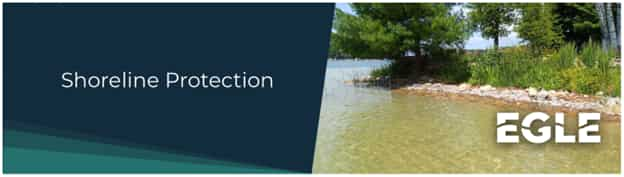
Michigan releases new guides for shoreline improvement

Michigan EGLE title block with a shoreline pictured on the right

The Michigan Department of Environment, Great Lakes, and Energy has developed a variety of new resources to assist individuals who want to improve their shoreline and learn more about bio-engineering and other inland lake best management practices. While Michigan’s regulations may be slightly different from Minnesota’s, the concepts for shoreline protection are the same, and anyone wanting to improve their shore can benefit from a review of this material.

The Michigan Department of Environment, Great Lakes, and Energy (EGLE) has developed a variety of new resources to assist individuals who want to improve their shoreline and learn more about bio-engineering and other inland lake best management practices. These have recently been published on EGLE’s Shoreline Protection website.

Five new fact sheets: 

Six new documents have also been created with illustrations and corresponding plans to implement best management practices for shoreline protection and lake health.

Note: these documents are consistent with Michigan’s shoreline regulations. While Michigan’s regulations may be slightly different from Minnesota’s, the concepts for shoreline protection are the same, and anyone wanting to improve their shore can benefit from a review of this material.

What goes on the lake, stays on the lake!

Graphic 'Keep It Clean' with forest and water in background

The “Keep It Clean” campaign was started to address the problem of garbage and waste left on the ice by anglers, campers and recreationists through education, legislation, and enforcement. While the ice fishing season has been shortened this year by the weather, the problem is real.

The Keep It Clean bill was signed into law in May 2023, making it illegal to place garbage and waste on or under the ice on Minnesota’s lakes and rivers. A civil penalty of $100 can be imposed for each violation. You can read the details of the law here.

MPCA releases draft list of Impaired Waters for 2024

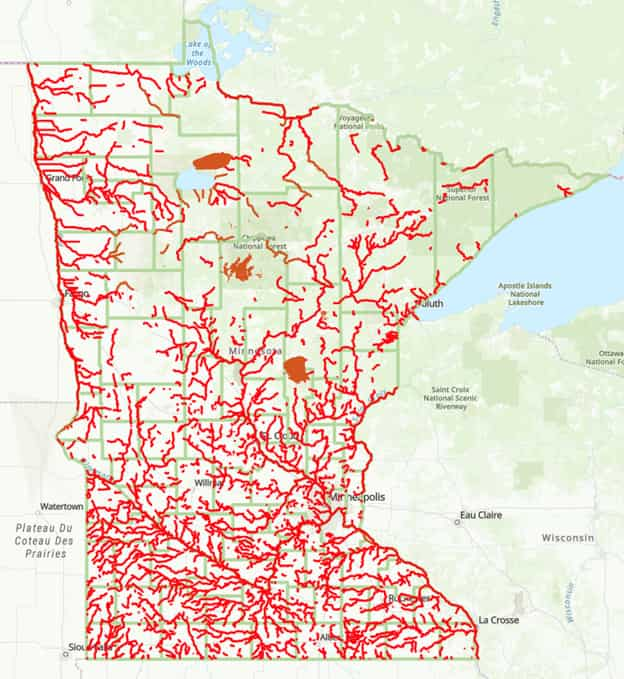
Map of Minnesota showing in redlines the impaired lakes and rivers

The 2024 Draft Impaired Waters List prepared by the Minnesota Pollution Control Agency includes 6,345 instances of impairments; note that a water body can have one or more impairments. In the 2024 draft, 222 additional pollutants or stressors instances were identified in Minnesota waters, while 27 were removed.

As required by the federal Clean Water Act, the Minnesota Pollution Control Agency (MPCA) assesses all waters of the state and creates a list of impaired waters every two years. This list includes waters that fail to meet water quality standards and uphold that water body’s designated use.

The 2024 Draft Impaired Waters List includes 6,345 instances of impairments; note that a water body can have one or more impairments. In the 2024 draft, 222 additional pollutants or stressors instances were identified in Minnesota waters, while 27 were removed.

Summary information along with a chart of pollutants and stressors can be seen here. The full Draft 2024 Impaired Waters List  is available in Excel format along with much more on MPCA’s Impaired Waters List page.

You also may find interesting insights in the MPCA’s Report to Congress dated November 2023 including special state concerns and recommendations regarding Endocrine active chemicals (EAC’s) and Per- and polyfluoroalkyl substances (PFA’s).

‘Forever Chemicals’ Contaminate America’s Freshwater Fish

A drawing of a plate with fish with hands holding a piece of fish on a fork
Image: OONA TEMPEST/KFF HEALTH NEWS

As reported in Kaiser Family Foundation Health News: This past March, the EPA proposed the nation’s first PFAS drinking water standards, but some scientists worry that regulations for freshwater fish are lagging. A recent study from The Environmental Working Group found that just one serving of fish can be equivalent to a month of drinking water contaminated with 48 parts per trillion of the common chemical PFOS. That is 12 times the EPA proposed limit for drinking water!

Minnesota is one of about 17 states that have issued guidance for consumption of freshwater fish, and their guidance is very specific. Follow the More information link below to read the Kaiser Family Foundation article and for links to the MN Department of Health guidance

To put this issue into context, here is some background on PFAS from the MN Department of Health.

Per- and polyfluoroalkyl substances (PFAS) are a family of human-made chemicals that have been widely used for decades. PFAS are extremely stable and do not breakdown in the environment. PFAS have been found in the groundwater and surface water in Minnesota. Some PFAS can build up and stay in the human body for many years. They can also slowly decline if the exposure stops.

PFAS, like other emerging contaminants, are the focus of active research and study, which means that new information is released frequently.

An article highlighting the issue of PFAS in freshwater fish was published in the Washington Post on January 4, 2024, with analysis by Hannah Norman and research by McKenzie Beard.

The full December 1, 2023, Kaiser Family Foundation Health News article by Hannah Norman provides insight on the issue, what the EPA research has found and where, and which states are providing guidance for consumption of freshwater fish.

The MN Department of Health has a webpage with fish consumption guidelines. That page provides many references to help keep you, your family, and your friends safe:

  • List of waterbodies with low PFAS
  • Statewide Safe-eating guidelines
  • Waterbody specific Safe-eating guidelines
  • And more

Please be aware that the MN Department of Health notes that some lakes and rivers in the East Metro Area of the Twin Cities have advised the pubic to not eat any fish due to high levels of PFOS in fish and/or water. Note: PFOS are a subset of PFAS and are a key concern as it related to consumption of fish.

September Member Meeting Recap

The MN COLA Membership meeting on September 19th was exceptionally content rich with the best meeting attendance ever. We heard about the impact of climate change on Minnesota, a new Watercraft AIS Cleaning Stations and Tools project, a special award for MN COLA, and our focus for the 2024 legislative session.

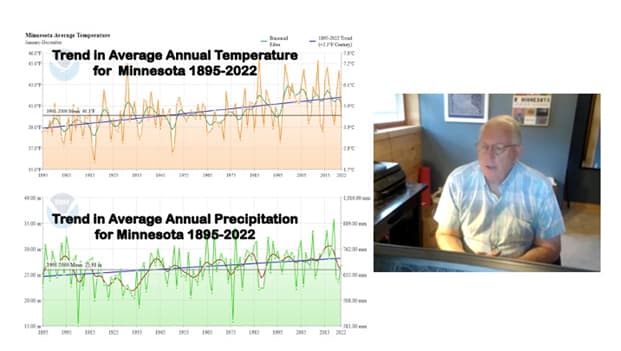
Mark Seeley describes temp and moisture increases in MN

If you were not able to make the MN COLA September 2023 Meeting, here is a quick summary of the great information:

  • Dr. Mark Seeley, renowned climatologist/meteorologist from the University of Minnesota, gave us a eyes-wide-open presentation about climate change, with a focus on Minnesota. There is a high degree of climate variability, and in particular, Minnesota is experiencing higher temperature and rainfall erraticism. Mega rains are more frequent and higher dew points are preventing cooling. Lakes are warming—particularly shallow lakes, and there is less ice cover in the winter.
  • Cass County Association of Lakes and Cass County Soil and Water shared a fantastic Best Practice in Action—their Watercraft AIS Cleaning Stations and Tools. By leveraging DNR relationships, strong project management, and deep engagement from a large stable of volunteers, over 55 cleaning stations have been installed in Cass County.
  • Clap and cheer! MN COLA has been selected as a Partner of the Year by the Minnesota Aquatic Invasive Species Research Center Research (MAISRC). We are delighted and honored to be recognized.
  • Legislative focus for 2024 – We had a robust conversation regarding the 2024 legislative focus; topics and strategy were fine-tuned, Clearly, the impacts of enhanced wakes are top of mind for MN COLA. Other subjects include AIS compliance, 2nd tier lake developments, AIS Prevention Funding, and sustaining funds for MAISRC.
  • The meeting concluded with our signature Round Robin session—a chance to chat and share what is on your mind. Hot topics included starry stonewort strategy, drainage issues, and regulations requiring an observer during towing.

A recording of Dr. Seeley’s portion of the meeting will be made available soon on the MN COLA website, under the Lake Resiliency section.

All are welcome to MN COLA Member meetings; the next meeting (Zoom) is Tuesday, December 5th—watch for more details!

MN COLA receives 2023 Partnership award from MAISRC

MAISRC Partnership Award  presented to MN COLA

Dr. Nick Phelps, Director of the Minnesota Aquatic Invasive Species Research Center (MAISRC), presented MN COLA with their 2023 Research Partnership Award for an organization.

Nick commented that “MN COLA has been an advocate for research-based solutions to our AIS problems from MAISRC’s beginning. From your docks to the State Capitol, you are out there; speaking the good word and trying to get important work done.” Nick also highlighted lake associations and COLA’s valuable help to MAISRC project teams, MN COLA’s help in disseminating research findings, and MN COLA’s advocacy for research and funding at the legislature.

Joe Shneider accepted the award on behalf of MN COLA and commented that “MAISRC is so vitally important for AIS prevention and control in Minnesota and far beyond. Their work is helping us better understand AIS infestations, what we can do now, and what might be possible in the future. We in Minnesota are so fortunate to have the kinds of access we have to the researchers and their ideas.”

MAISRC gives out Research Partnership Awards for individual partnership contributions and to local government partners in addition to the award to an organization.

AIS Infestations rising in 2023

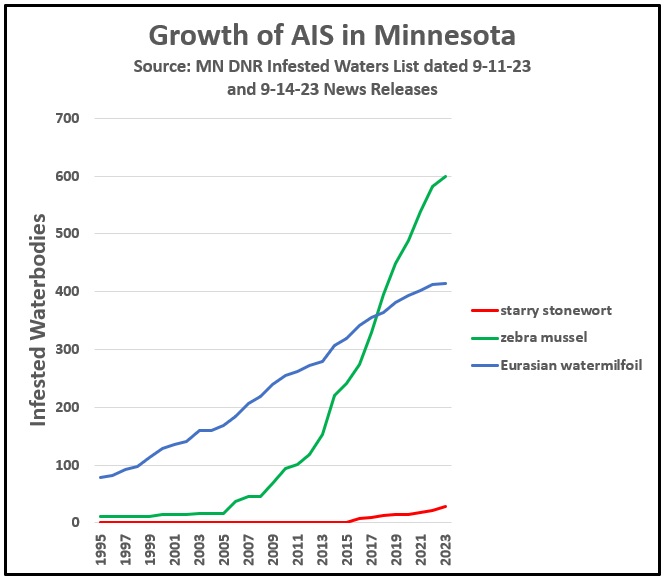
Chart of AIS growth in MN 1995-2023-starry stonewort, zebra mussel, and EWM

Death by a thousand cuts! We can become immune to the repeated announcements of new lakes becoming infested with AIS, but we shouldn’t. The season for reporting AIS infestations is not over and we should expect the 2023 numbers will grow.

The 3 species graphed above threaten the recreational value of our public waters, and they keep growing, increasing the annual costs to keep the species under control and the lakes usable.

So far in 2023, we have 6 new infestations of starry stonewort: up from 22 since 2015. That’s a 27% increase this year alone. A troubling growth rate for a very troubling species that is still early in its infestation life cycle.

Zebra mussel infestations year to date are up 17 on a base of 582. If that low double-digit increase holds, it will have been a good year. Be aware that more infestations typically get identified as we pull out boats, docks, and lifts.

Eurasian watermilfoil only racked up 2 new infestations so far, so perhaps it’s trending down. And that’s good.

While waterbody counts may be slowing, you should be aware that most large lakes in Minnesota have 1 or more AIS, and the percentage of Minnesota’s surface water infested with AIS is very high.

Vanishing natural shorelines hurt lake quality

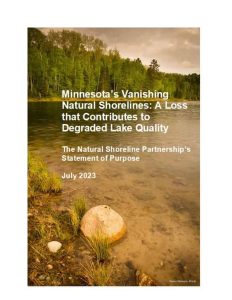
Image of the front cover of the report

In June 2022, Paul Radomski from the MN DNR presented the ideas from this newly released paper at our MN COLA Annual meeting. This was one of the sessions in our Lake Resiliency series.

Now the Vanishing Natural Shorelines paper has been published and you can read the whole story of how the loss of natural shorelines contributes to the degrading of lake quality. Tom Nelson, MN COLA Secretary and Itasca County SWCD Board member, was a key contributor from MN COLA. We encourage you to read and disseminate this document.

As Steve Kloiber from the MN DNR has written: “The Minnesota Natural Shoreline Partnership was formed around the idea that regulatory approaches to shoreland protection have not been sufficient to stop the loss of natural shoreland. This group has chosen to focus on the idea that there is a need to change social norms around how people think of their shoreline.”

We should individually and collectively do everything we can to stop the loss of natural shorelines and reclaim lost shorelines. Let’s change the social norm so natural shorelines are preferred.

Metro legislators rocked by surfing

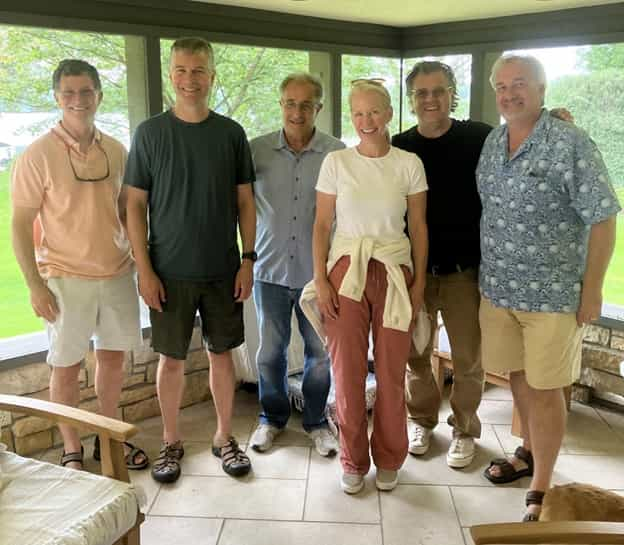
MN COLA President Joe Shneider along with MLR Executive Director Jeff Forester and Marina owner Gabe Jabbour took several legislative leaders out on Lake Minnetonka in late August to see wakesurfing in action. From left to right are MN COLA President Joe Shneider, Environment and Natural Resources Committee Chair Rep. Rick Hansen, Rep. Larry Kraft, Sen. Kelly Morrison, MLRA’s Jeff Forester, and Marina owner Gabe Jabbour.